A shutter is often one of the first things people notice when entering a shop, warehouse, factory, or commercial building. While its primary purpose may appear to be security, a rolling shutter also influences ventilation, accessibility, space utilisation, weather protection, and the everyday convenience of operating a building.
The role of a Rolling Shutter manufacturer in India goes beyond producing metal shutter panels. It involves understanding different building requirements, selecting suitable materials, designing shutter mechanisms, and ensuring that the finished system can operate reliably under regular use.
With India’s diverse climate, architectural styles, commercial environments, and industrial requirements, rolling shutters have evolved into several types and designs. Understanding these differences can help property owners, architects, contractors, and facility managers make more informed decisions.
What Is a Rolling Shutter?
A rolling shutter is a door or protective covering made from interconnected horizontal slats or profiles. These slats are designed to move vertically, allowing the shutter to open and close by rolling around a drum or shaft positioned above the opening.
Unlike conventional doors that require space for swinging, rolling shutters generally move upward and remain compact when opened. This makes them useful in locations where floor space is limited or where a wide entrance needs to remain unobstructed.
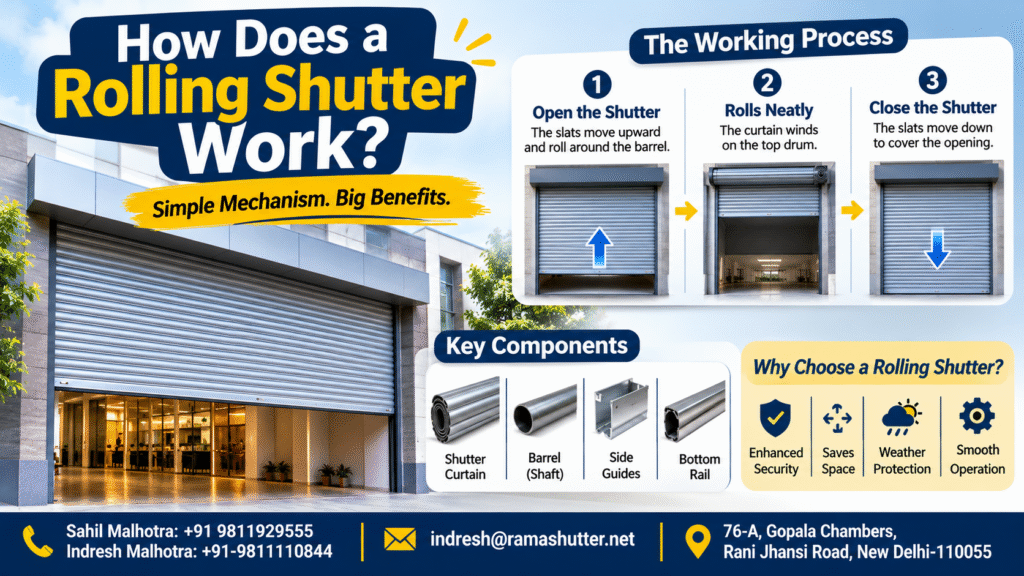
The basic mechanism consists of:
- Shutter curtain made from interconnected slats
- Barrel or shaft for winding the curtain
- Side guides that control vertical movement
- Bottom rail for stability
- Springs or other balancing mechanisms, depending on design
- Manual or motorised operating mechanism
Although the basic principle remains similar, the construction, materials, dimensions, and operating systems can differ considerably depending on the intended application.
How Does a Rolling Shutter Work?
The working principle of a rolling shutter is relatively simple but involves several components working together.
When the shutter is opened, the interconnected slats travel upward along the side guides and gradually wrap around the barrel located above the opening. When closed, the curtain moves downward and covers the entrance.
In manually operated shutters, movement is controlled through a hand-operated mechanism, spring arrangement, chain, or other suitable operating system.
Motorised rolling shutters use an electric motor to rotate the shaft. Depending on the installation, the operator may use a switch, remote control, or integrated control system.
The smoothness of operation depends on several factors, including:
- Correct alignment of side guides
- Appropriate shutter dimensions
- Balanced weight distribution
- Quality of the operating mechanism
- Proper installation
- Regular maintenance
A shutter may look simple from the outside, but its performance depends on how accurately these components are designed and assembled.
Different Materials Used in Rolling Shutters
Material selection is one of the most important aspects of rolling shutter design. Different metals offer different characteristics in terms of strength, weight, corrosion resistance, appearance, and maintenance.
1. Mild Steel Rolling Shutters
Mild steel is commonly used in applications where structural strength and durability are important. It is suitable for many commercial and industrial entrances, depending on the shutter design and specifications.
Protective coatings and suitable surface treatments can help reduce corrosion, particularly in environments exposed to moisture.
2. Galvanised Iron Rolling Shutters
Galvanised iron or galvanised steel products feature a zinc coating designed to provide additional protection against corrosion.
These shutters may be considered for locations where exposure to environmental conditions is a concern. The actual performance depends on the quality of galvanisation, the surrounding environment, and maintenance.
3. Aluminium Rolling Shutters
Aluminium is comparatively lightweight and can be useful where reduced shutter weight, appearance, and ease of operation are important considerations.
Aluminium rolling shutters are commonly associated with commercial storefronts, showrooms, and applications where the design needs to balance functionality with aesthetics.
4. Stainless Steel Rolling Shutters
Stainless steel offers corrosion resistance and a distinctive finish. It may be suitable for selected commercial, institutional, or specialised environments.
The appropriate stainless steel grade depends on exposure conditions, cleaning requirements, and the intended use of the shutter.
Types of Rolling Shutters Based on Design
Not every entrance requires the same shutter configuration. The design should be selected according to the opening, visibility requirements, ventilation, security expectations, and operating frequency.
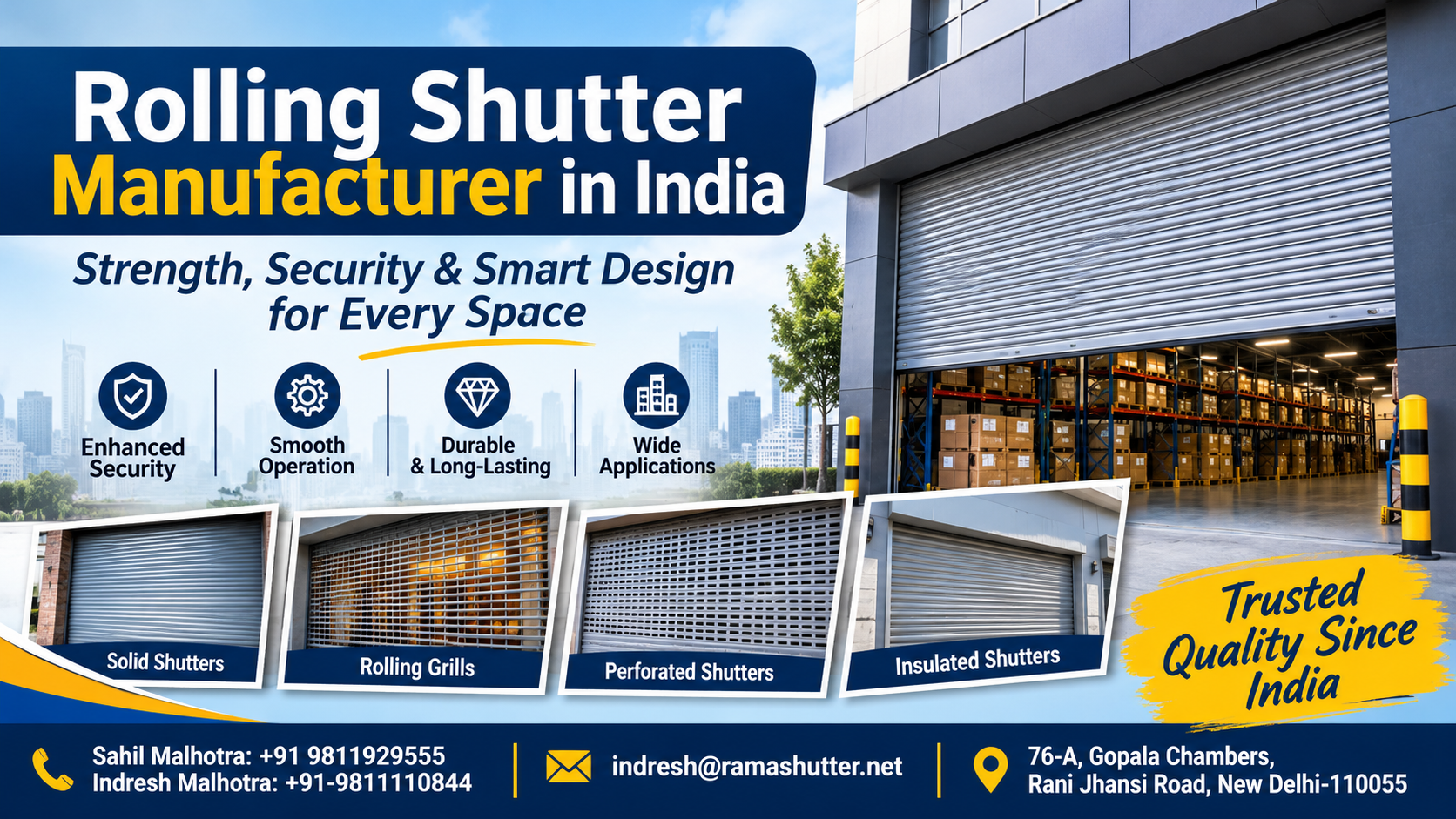
Solid Rolling Shutters
Solid shutters provide a closed barrier across the entrance. They are often used for shops, storage spaces, workshops, warehouses, and industrial facilities where privacy and protection from external access are important.
Rolling Grills
Rolling grills use an open or perforated construction that allows visibility and airflow even when the entrance is closed.
They can be useful in shopping centres, retail stores, parking areas, and commercial spaces where displaying the interior or maintaining ventilation is desirable.
Perforated Rolling Shutters
Perforated shutters incorporate openings within the shutter profiles. Their design allows a balance between visibility, ventilation, and enclosure.
The size, pattern, and distribution of perforations influence the appearance and functional characteristics of the shutter.
Insulated Rolling Shutters
Insulated shutters incorporate insulation within their construction to help reduce heat transfer.
They may be considered for buildings where temperature management, energy efficiency, or internal environmental conditions are important. The overall thermal performance depends on the complete shutter system and installation.
Where Are Rolling Shutters Used in India?
Rolling shutters are found across many sectors because they can be adapted to different types of openings.
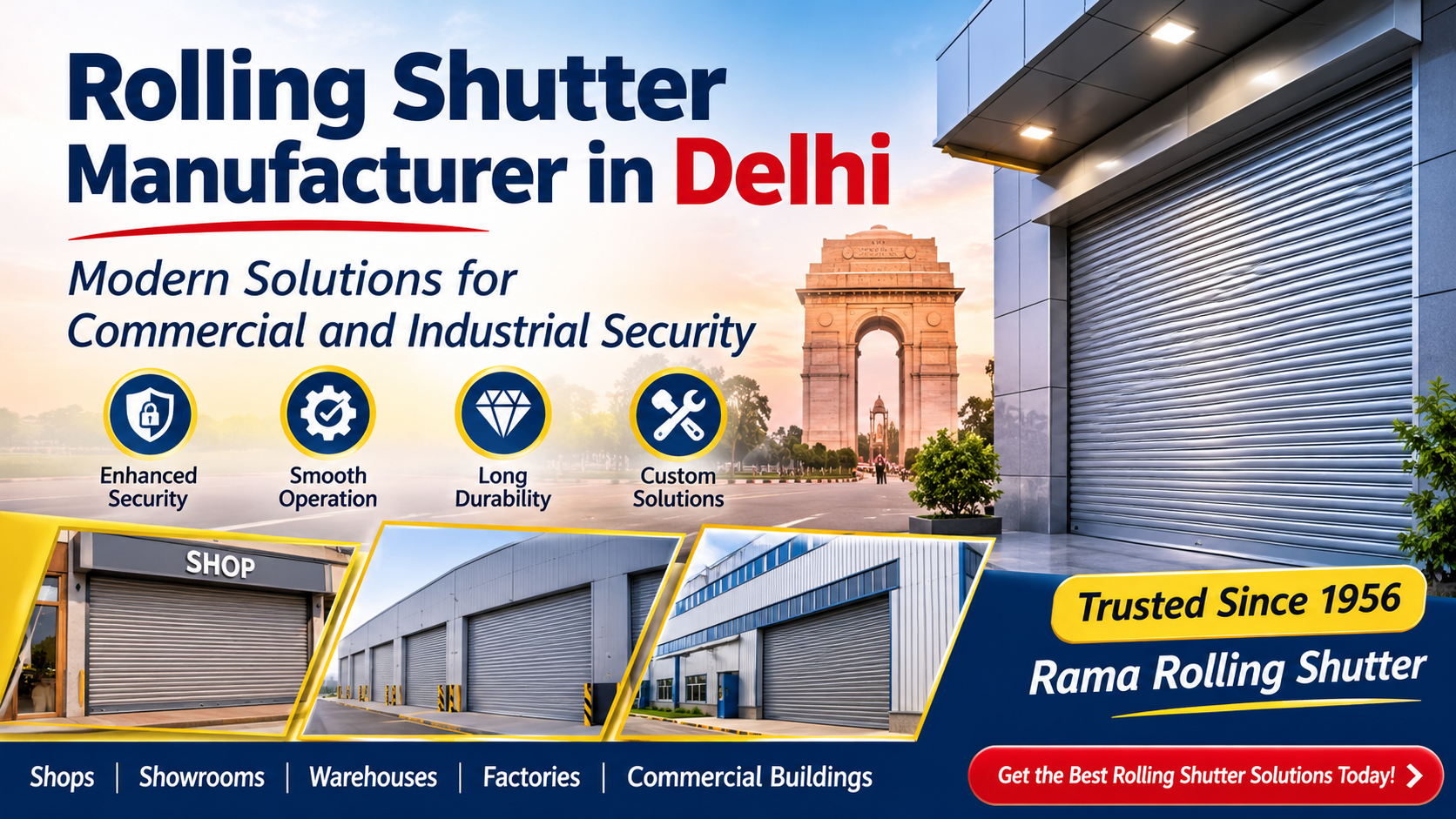
Retail shops and showrooms: Shutters provide a closing barrier outside business hours while helping maximise the available entrance space.
Warehouses: Large openings can accommodate the movement of goods, equipment, vehicles, and material-handling operations.
Factories and industrial units: Rolling shutters can be used for production areas, loading zones, storage sections, and equipment access points.
Parking facilities: Shutters and grills can help control vehicle entry and exit while supporting the requirements of the parking area.
Commercial buildings: Shops, offices, service centres, and other facilities may use shutters for access control and space management.
Residential properties: Rolling shutters may be installed in garages, storage areas, shops within residential buildings, and selected external openings.
The application determines the type of shutter, material, operating mechanism, and construction requirements.
Manual vs Motorised Rolling Shutters
The choice between manual and motorised operation depends largely on the size of the shutter, how frequently it is used, and the convenience required.
Manual Rolling Shutters
Manual shutters operate without an electric motor. They can be appropriate for smaller openings or locations where opening and closing are required only a few times a day.
Their performance depends on proper balancing, the operating mechanism, and the weight of the shutter curtain.
Motorised Rolling Shutters
Motorised shutters use an electrical operating system to open and close the shutter.
They can be beneficial for larger shutters, frequent operation, commercial facilities, and locations where manual handling may be inconvenient.
Motor selection should consider shutter weight, dimensions, operating frequency, and the required control arrangement. Safety features and emergency operation should also be considered during system selection.
What Determines the Quality of a Rolling Shutter?
The appearance of a shutter does not always reveal how well it will perform over time. Several manufacturing and installation details influence its functionality.
Material Thickness and Profile Design
The dimensions and thickness of shutter profiles influence their structural characteristics. However, thicker material alone does not automatically guarantee better performance.
The design must consider the width and height of the opening, expected usage, wind exposure, operating mechanism, and the overall construction.
Alignment and Assembly
Side guides, barrel alignment, curtain assembly, and the operating mechanism need to work together.
Incorrect alignment can contribute to friction, uneven movement, noise, and premature wear.
Operating Mechanism
The spring arrangement, motor, shaft, bearings, and associated components should be suitable for the shutter’s dimensions and operating requirements.
Installation Accuracy
Even a well-manufactured shutter may not perform as intended if it is installed incorrectly.
Proper positioning, guide alignment, fixing arrangements, and adjustment are essential parts of the installation process.
Surface Protection
Metal shutters may be exposed to dust, humidity, rain, pollution, and temperature variations. Appropriate surface treatment and coating can help protect the material and maintain its appearance.
How India’s Climate Influences Rolling Shutter Design
India experiences a wide range of climatic conditions, including hot summers, monsoon rainfall, coastal humidity, dust, and colder winter conditions in some regions.
These environmental factors can influence shutter material selection, surface protection, maintenance frequency, and installation requirements.
In coastal locations, corrosion resistance may become particularly important. In dusty industrial areas, cleaning and maintenance of guides and moving components can help maintain smoother operation.
In regions with strong winds, the shutter’s dimensions, structural design, anchoring, and wind-load requirements should be assessed according to the location and application.
There is no single shutter design suitable for every environment. A shutter installed in a small retail shop may have different requirements from one installed in a large industrial warehouse.
Common Rolling Shutter Problems and Their Causes
Understanding common operational problems can help identify maintenance requirements before they become serious.
Shutter becomes difficult to operate: This may result from misaligned guides, friction, inadequate balancing, damaged components, or accumulated dirt.
Unusual noise during movement: Noise can be associated with worn components, loose fixings, friction, poor alignment, or a mechanism requiring inspection.
Uneven opening or closing: This may indicate alignment problems, curtain damage, imbalance, or issues with the operating system.
Motor stops working: Electrical supply problems, motor faults, control-system issues, or excessive load may affect operation.
Rust or surface deterioration: Moisture exposure, damaged protective coatings, environmental conditions, and insufficient maintenance may contribute to corrosion.
Identifying the underlying cause is more useful than simply treating the visible symptom.
Rolling Shutter Maintenance: Small Steps That Make a Difference
Routine maintenance can help extend the useful life of a rolling shutter and support consistent operation.
- Keep the side guides free from dust, debris, and obstructions.
- Inspect the shutter curtain for damaged or bent slats.
- Check visible fixings and structural connections periodically.
- Observe whether the shutter opens and closes evenly.
- Pay attention to unusual sounds or increased operating resistance.
- Inspect protective coatings for damage or corrosion.
- Have motorised systems checked by a qualified technician.
- Avoid forcing a shutter that has become jammed or misaligned.
Spring mechanisms, electrical components, and motorised systems may require professional inspection rather than DIY adjustments.
What Should Be Considered Before Installing a Rolling Shutter?
Before selecting a shutter, it is useful to evaluate the entrance and its intended purpose.
- Opening dimensions: Accurate measurements of width and height are essential.
- Usage frequency: A shutter used several times daily may require a different operating mechanism from one used occasionally.
- Environment: Indoor, outdoor, coastal, dusty, and industrial environments have different requirements.
- Visibility and ventilation: Solid shutters, grills, and perforated designs offer different levels of airflow and visibility.
- Operating method: Manual or motorised operation should be selected based on practicality.
- Safety: Consider safe operation, access controls, emergency arrangements, and the surrounding pedestrian or vehicle movement.
- Maintenance access: The installation should allow suitable inspection and servicing of operating components.
Careful planning helps avoid selecting a shutter solely on the basis of appearance or initial cost.
Frequently Asked Questions
What is the purpose of a rolling shutter?
A rolling shutter is used to cover and control access through an opening. Depending on its design, it may provide security, privacy, weather protection, ventilation, visibility, and convenient space-saving operation.
Which material is suitable for rolling shutters?
Mild steel, galvanised steel, aluminium, and stainless steel are used for different applications. The appropriate material depends on the opening dimensions, environment, structural requirements, appearance, and maintenance expectations.
Are motorised rolling shutters better than manual shutters?
Neither option is universally better. Manual shutters may be practical for smaller openings with limited operating frequency, while motorised systems can provide convenience for larger or frequently used entrances.
Can rolling shutters be customised?
Rolling shutters can be designed according to the opening dimensions, shutter profile, material, finish, operating mechanism, and application requirements.
How often should rolling shutters be maintained?
Maintenance frequency depends on usage, environmental conditions, and the operating system. Regular visual inspection and periodic professional servicing are recommended, particularly for frequently operated or motorised shutters.
Why do rolling shutters make noise?
Noise may be caused by friction, misalignment, worn components, loose connections, dirt in the guides, or problems with the operating mechanism. Inspection is recommended if the noise becomes unusual or increases over time.
Conclusion
Rolling shutters are more than metal barriers covering an entrance. Their design combines material selection, mechanical movement, structural considerations, installation accuracy, and everyday functionality.
Understanding these factors helps explain the work involved in the rolling shutter manufacturing process in India and why different applications require different shutter configurations.
Whether installed in a retail shop, warehouse, factory, parking facility, or commercial building, a well-designed rolling shutter should be selected according to its intended use, operating conditions, and maintenance requirements.
The most suitable shutter is not necessarily the one with the most complicated design, but the one whose construction and mechanism are appropriate for the environment in which it will operate.